
From the YARD in Kreuzberg you walk to the Jewish Museum Berlin in about ten minutes. Architecture, exhibition and a quiet base afterwards.
The Jewish Museum Berlin on Lindenstraße is Europe’s largest Jewish museum. Libeskind’s building is part of what you experience, not just a shell around it. From our the YARD Berlin on Alexandrinenstraße you can walk there in about ten minutes.
Jewish life past and present
You come here when you want Jewish life in Germany as history, everyday life and the present. The permanent exhibition “Jewish History and Present in Germany” tells that story across more than 3,500 square metres, from a Jewish perspective, from the Middle Ages to today. Five historical chapters take you from early Ashkenaz through the early modern period and emancipation to the catastrophe of the Nazi era and the chapter after 1945. That last stretch gets real weight, from new beginnings and restitution to Russian-speaking immigration and the many voices of Jewish everyday life now.
Eight theme rooms sit alongside the chronology and look at religion and culture beyond a straight timeline. You meet the Torah, questions around commandment and prayer, Shabbat, sound and Kabbalah, and you hear people describe how Jewish life is lived today. More than 1,000 objects, media stations and installations make belonging and exclusion tangible, and the rooms tend to stay with you. The museum sits right in Kreuzberg.
The ensemble is the baroque old building, Daniel Libeskind’s zigzag, the W. Michael Blumenthal Academy and ANOHA, the children’s world in the former wholesale flower market hall. You can give an afternoon to the architecture alone, or weave exhibition, garden and neighbourhood together.
Architecture you can feel
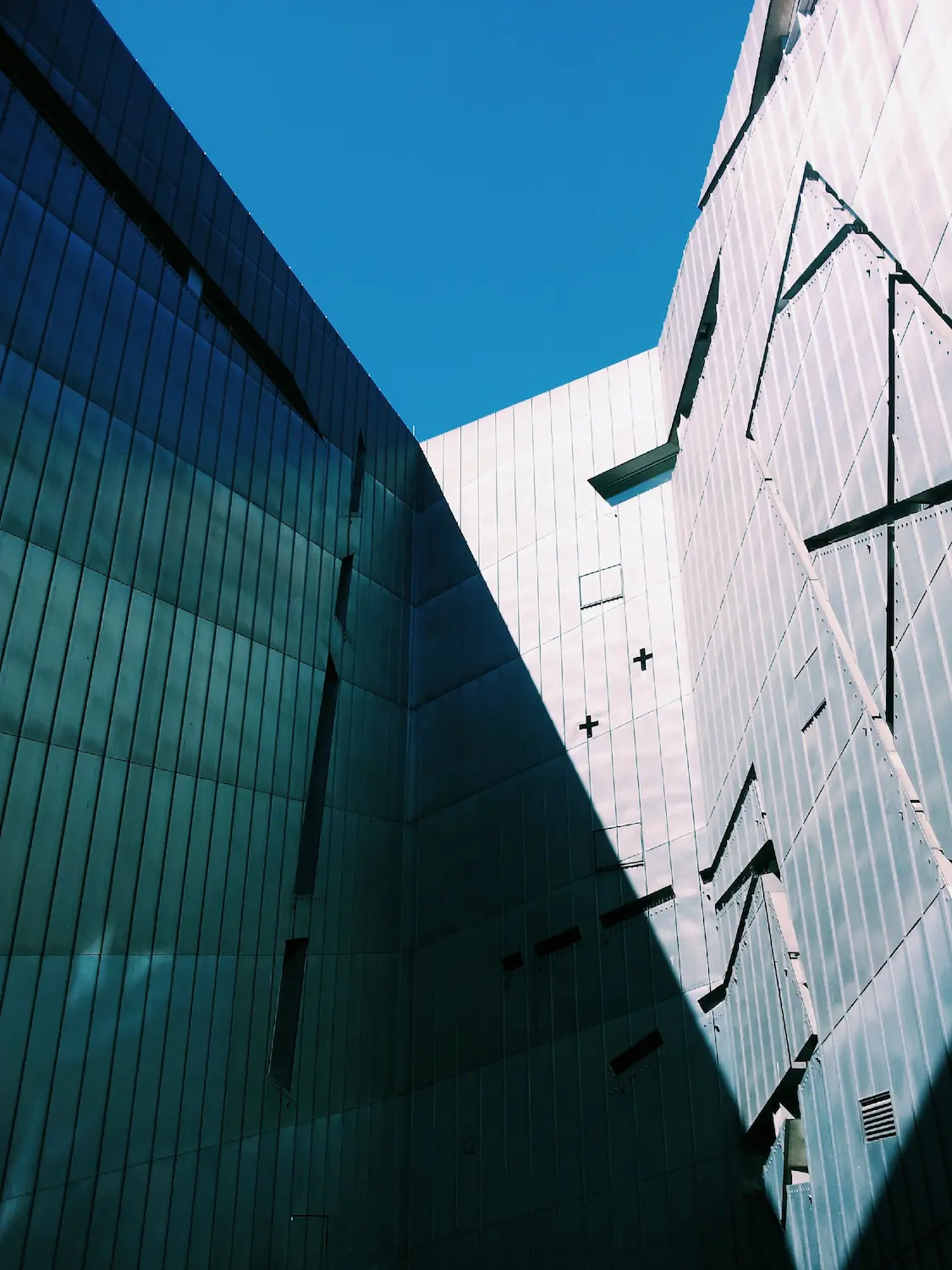
Daniel Libeskind called his design Between the Lines. He did not want a neutral museum box. He wanted to tell German-Jewish history. The Libeskind Building was his first completed museum. From outside the titanium-zinc zigzag stands on its own, and the slanted windows hide any clear floor levels. You enter next door, through the baroque old building, the former Kollegienhaus. It is the last surviving baroque palace in historic Friedrichstadt. Ticket desk, cloakroom and information sit there, plus the temporary exhibition spaces, museum shop and café. The Libeskind Building and the permanent exhibition are reachable only underground.
Two lines shape the floor plan. One you see as the zigzag, the other stays invisible and straight. Where they cross, you find the Voids, empty concrete shafts that run from the basement to the roof. They are largely without climate control or artificial light, and they make the loss of Jewish life in the Shoah physically felt. Some people read a lightning bolt in the plan, others a broken Star of David. The deliberate disorientation leaves room for interpretation and keeps you thinking.
In the basement three axes cross. The Axis of Exile, the Axis of the Holocaust and the Axis of Continuity stand for different Jewish paths through Germany. Along them, objects speak of persecution, emigration and memory. The Axis of Exile leads into the Garden of Exile. Forty-nine steles stand on sloping ground, with oleaster shrubs growing out of the tops. The Axis of the Holocaust ends in the Holocaust Tower, a cool, dark concrete shaft with a narrow slit of light. The place works without explanation. Via the Axis of Continuity and a long staircase you later reach the permanent exhibition. Upstairs, Void bridges mark the empty spaces in the building.
Current temporary exhibitions are listed on the museum website.
How to plan your visit
Open Tuesday to Sunday from 10:00 to 18:00, last admission at 17:00. Mondays the house is closed, plus closure days on major public holidays. Opening hours and closure days are best checked on the visit information page.
Admission to the permanent exhibition and much of the Libeskind Building is free. Temporary exhibitions in the old building currently cost €10, reduced €4, under 18 free, according to the museum. A timed ticket in the online shop shortens the wait. Tickets are also available at the desk, and ANOHA needs its own time slot.
Two hours is the minimum. Three is more realistic if you take architecture and exhibition seriously. Access to every exhibition is through the old building. Do not look for a front door in the zinc façade.
Ten minutes through Kreuzberg
When you head out from our the YARD along Alexandrinenstraße, you start on a quiet residential street between old buildings. After about ten minutes you reach Lindenstraße and stand in front of the titanium-zinc zigzag with its slanted windows. The entrance is in the baroque old building next door. From there you go underground into the Libeskind Building.
If you still have energy after the museum, you can use the same corner of the city for two more stops. The Berlinische Galerie and its modern art collection sits on Alte Jakobstraße, east of Checkpoint Charlie and closer to the museum. Checkpoint Charlie itself is about ten minutes on foot. Both fit neatly onto the end of the day if you want them.
More on the location in Kreuzberg is on our Hotel Kreuzberg Berlin page.
ANOHA with kids
ANOHA is the museum’s children’s world for kids aged three to ten, and it is part of the same ensemble. As soon as you walk in, the big round wooden ark fills the room. Some children see a UFO in it, others a bagel. On and around it live about 150 animal sculptures. Fifteen artists spent two years building them from recycled materials and everyday objects. Kids can touch the animals, greet them, feed them or climb on them. Some sculptures work as climbing frames, others as loungers, instruments or marble runs. Extinct and endangered species are part of it too, so conservation sits naturally inside the play.
Around the ark you find the play stations. On the 14-metre water track you test whether the boat you built actually floats, trigger a small flood or dam the water. In Unicorn Class everyone learns from everyone else, and in the centre of the ark you can look through futuroscopes and gather ideas for life after the flood. At the rainbow it is about choices, and in the listening treasure hunt someone is still missing from the ark.
ANOHA is a sock-only museum. Bring non-slip socks if you can. You can also buy them on site for €3. ANOHA recommends about two hours. Booking a timed ticket ahead is worth it.
At our the YARD Berlin we also have family rooms with two doubles and a connecting door, or space for three guests.
Across from the museum on Fromet-und-Moses-Mendelssohn-Platz sits the W. Michael Blumenthal Academy in the former wholesale flower market hall. Front and centre are the library with a public reading room, the archive and the Klaus Mangold Auditorium for events. Seminar and workshop rooms belong to the house as well.
Back at the YARD
After a day in the exhibition you can unwind properly in our spa. Have a sauna, jump in the pool or put in a short session on the fitness equipment. What that looks like day to day is in our spa article about the YARD.
If you want to round off the evening with a good meal after the spa, our restaurant guide for Kreuzberg is ready, with Rutz Zollhaus as a nearby first tip.
Our the YARD Berlin on Alexandrinenstraße
If you want to approach the Jewish Museum Berlin from a quiet Kreuzberg residential street, our the YARD Berlin is built for that. Online check-in and a 24-hour reception come with the house. The hotel is a solid home base for whatever Kreuzberg day you are planning.
On the hotel page you will find rooms, location and direct booking. For more Kreuzberg before you arrive, browse our little BIG stories.