
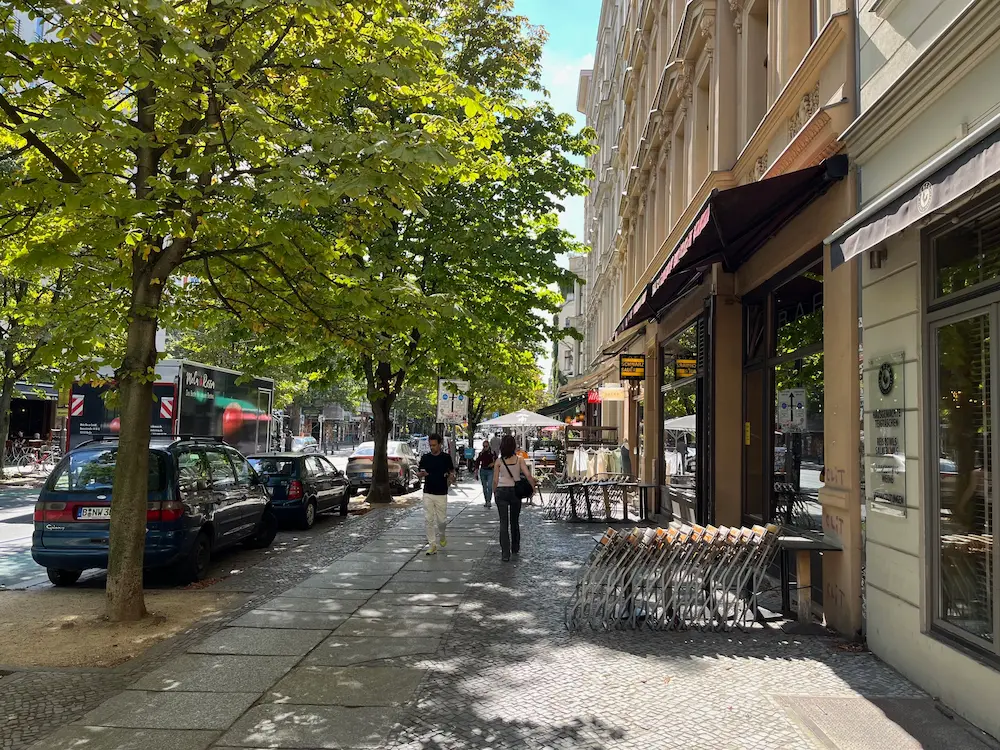
Our Prenzlauer Berg guide from CALMA. Berlin's famous neighborhood between subculture and gentrification. Enjoy a day beyond the usual Berlin stops.
From CALMA into Prenzlauer Berg
Prenzlauer Berg is a cult neighborhood in Berlin. Since the Wall came down it has kept reinventing itself, and that is still what makes it interesting. If you are in the city, set aside a day here. Subculture and gentrification sit right next to each other. Honestly, gentrification usually wins, and you often have to look a little further for the subcultural edges. Even so, Prenzlauer Berg makes for a good day: browse, eat, pause, keep walking. If you want to see Berlin beyond the usual sights, we’ll show you what your neighborhood day could look like. And you do not need to stay in the middle of Prenzlauer Berg to do it. With our CALMA Berlin Mitte on Linienstraße, you’ve got a solid starting point for exactly this kind of day.
From CALMA you head via busy Rosenthaler Platz up Weinbergsweg onto Kastanienallee, then along Oderberger Straße to Mauerpark. After that, the Berlin Wall Memorial on Bernauer Straße, the Kulturbrauerei, Kollwitzkiez or Helmholtzplatz, and optionally Volkspark Friedrichshain, are ahead of you. You can rent bikes from us at CALMA at reception. By bike you take the same route on the cycle lane and stay a little more alert because of the tram. If you want to avoid the tracks entirely, take Choriner Straße running parallel.
From Rosenthaler Platz up the hill
Prenzlauer Berg is not called that for nothing. From Rosenthaler Platz up Weinbergsweg it really climbs, and you feel it in your legs by the time you reach Oderberger Straße and Kastanienallee at the top. By bike it quickly turns into a little Tour de France moment. Officially you are still in Mitte here. Tram tracks run along Weinbergsweg the whole way. If you want to skip the climb, take the tram from Rosenthaler Platz and hop off higher up.
Right at the start, before the park section proper, cafés, bakeries and small shops sit close together. Café Fleury at Weinbergsweg 20 has been one of the best-known spots for years: French, homemade, and the terrace is often packed. If it is too full, grab something from the bakery instead, for example Zeit für Brot at Weinbergsweg 2, known for its cinnamon rolls and breads, and sit in Weinbergspark. Plenty of people do exactly that.
Weinbergsweg and Castingallee
Once Weinbergspark starts on the left, the right side goes quiet for a stretch: mostly residential buildings, little to browse. You can also walk up through the park and rejoin Weinbergsweg further up. Between the start of the park and Fehrbelliner Straße, this strip is more passage than shopping street.
In the middle of Weinbergspark sits Coccodrillo, an Italian restaurant with one of the most exposed terraces in this corner of the city. You sit practically in the green while Weinbergsweg keeps climbing beside you, and you can pause before Kastanienallee really kicks off.
From Fehrbelliner Straße the shops come back to life. Then Kastanienallee takes over, once often called Castingallee: boutiques, shops, bookstores, food. The climb turns back into a street for dipping in and out.
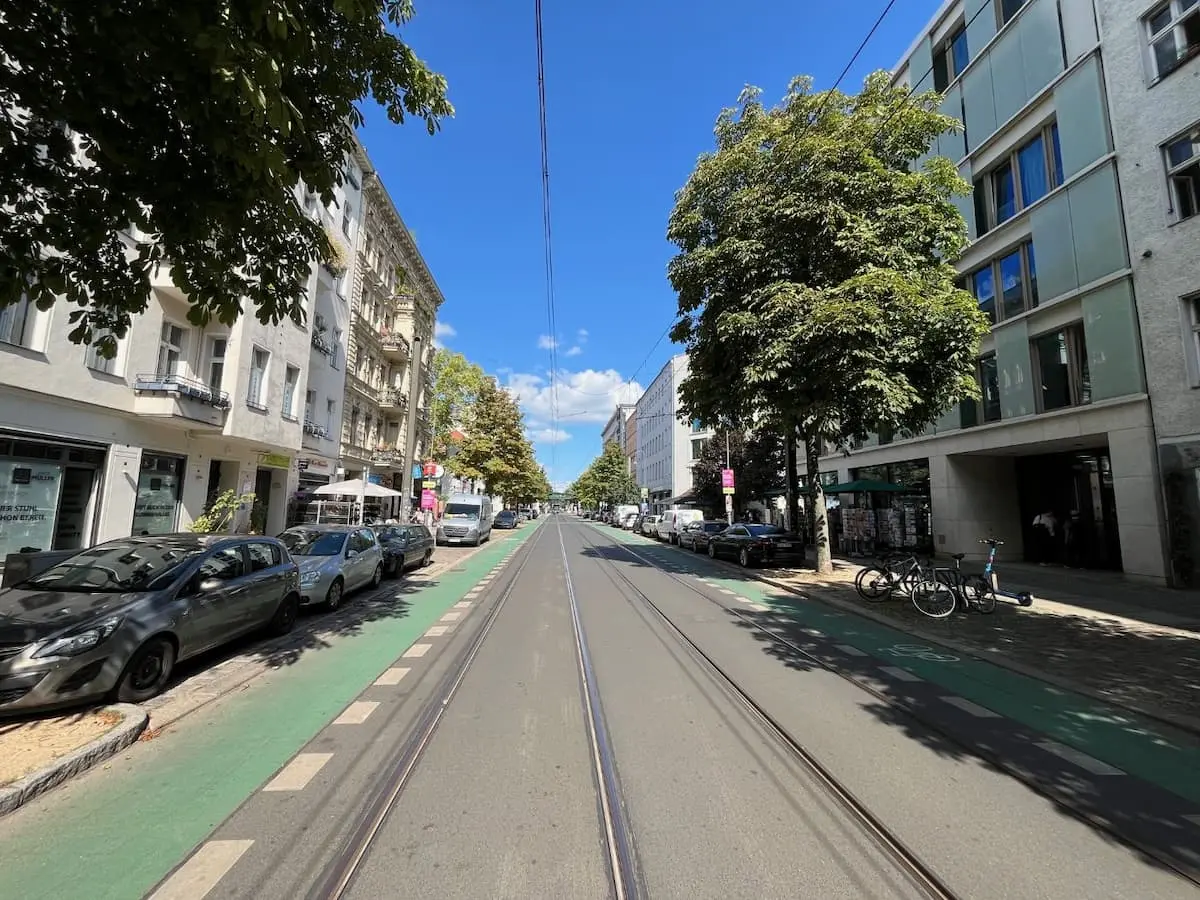
Along Kastanienallee the food landscape is dense, from Japanese and Korean to Persian and falafel, Vietnamese and more Asian, street food and seats packed close together. Babel at Kastanienallee 33 is the Lebanese classic, often so busy you should plan for a wait. Further up at the corner with Oderberger Straße you find The Flying Monkey, Asian fusion with a similar crowd.
Berlin fashion designers with their own boutiques used to sit here. Most of them are gone. One original remains: Eisdieler at Kastanienallee 12. Since the nineties, individual menswear from their own Berlin atelier and selected accessories. Definitely look in if you care about fashion beyond chain stores.
From Kastanienallee at Schwedter Straße, Prenzlauer Berg officially begins. And then Prater at Kastanienallee 7–9: in summer Berlin’s oldest beer garden under the chestnut trees. Year-round, the Prater Gaststätte next door is the better bet, with solid German cooking, house beer and classics like Königsberger Klopse. That keeps the stop interesting in winter too.
That is how this stretch works: poke your head in, step inside, or simply keep walking.
Oderberger Straße to Mauerpark
Oderberger Straße is shorter than Kastanienallee and often more personal, with small boutiques, cafés and people carrying ice cream or a Späti beer. The Spätis along the street are the supply line for many Mauerpark visitors before they head on. Hokey Pokey at Oderberger Straße 38 is the locally famous ice cream patisserie and, for many, a must-stop before the park. Further towards Mauerpark sit craft beer shops and Il Giradischi, deep in the punk rock scene. Vinyl covers of punk albums from the last thirty, forty years hang on the walls, and that is why the place has such a distinct vibe. The pizza has been a neighbourhood favourite for years.
The old fire station on Oderberger Straße is one of those anchors where you briefly stop, even when you are on your way to the park. Then Mauerpark opens up. On Sundays the flea market has long been an institution, half the city seems to be there, between second-hand, street food and street music. From mid-May to mid-October the amphitheatre often adds open karaoke, Sundays from about 3 pm when the weather is good, and that remains one of the park’s big hits. Another highlight is the long-rope swings where you can really get height. Right by the park, where Eberswalder Straße meets Bernauer Straße, Mauersegler has sat since 2003: beer garden, café and food stop for flea-market and park days, often with live music in summer. In the same area is Tante Käthe, the football and foosball pub with screens and tables, right on the border between Prenzlauer Berg and Wedding. On other days you can catch your breath here, have a coffee or simply sit and watch the city. The park can feel a little rougher and wilder than a classic city park, and that is exactly why it feels like a real piece of Berlin.
Wall and memory
At the end of Oderberger Straße, towards Bernauer Straße and slightly hidden behind the Denn’s organic supermarket, the path to the Berlin Wall Memorial begins. You can enjoy the park and still take a piece of history with you, without planning a full museum day. That is what makes this detour interesting: how it used to look here, and what you see today. Hardly anyone pictures themselves standing or walking in the former death strip. And yet the path tells you how the divided city worked.
It is an open-air museum. Steles and steel markers sit in the grass where the Wall once stood, because of the Wall itself you barely see anything left. Outdoor exhibition, Wall documentation, signs and panels walk you along the old border line. The memorial proper on Bernauer Straße is about ten to fifteen minutes on foot. Here the journey is the point. You walk yourself into the history, so to speak.
If you are exploring Prenzlauer Berg properly, plan this detour. You walk through Berlin city history, and it takes longer than a quick side trip. Afterwards you see the neighbourhood with different eyes.
Schönhauser Allee, Kulturbrauerei and Wen Cheng
From Mauerpark the easiest way is through the Gleimviertel and down Gleimstraße to Schönhauser Allee. Alternatively take the short Eberswalder Straße and you land closer to the Kulturbrauerei. Schönhauser itself is more axis than stroll, with tram, pace and north–south through-traffic. What sits in the middle is the Kulturbrauerei, a culture complex with cinema, clubs and events, and the Franz Club is part of it if you want to stretch the evening.
For hunger in between we recommend Wen Cheng at Schönhauser Allee 65. Hand-pulled Biang Biang noodles, often with a queue at the door and sometimes proper heat that you choose yourself. You cannot reserve, so come early or plan for a wait.
Helmi and Kollwitzkiez
Wen Cheng already sits close to Helmholtzplatz, Helmi for short. From here the east side of Schönhauser makes a neat loop: first Stargarder Straße north of the square, then back to Helmi and south through the neighbourhood to Kollwitzplatz and the water tower.
Stargarder Straße is one of the best-known neighbourhood axes here: for a good kilometre, lively local life, hairdresser, florist, bakery, cafés and restaurants, everything you need day to day within a few minutes’ walk. At the Gethsemane Church the street also remembers opposition in the GDR, vigils, and how from here in autumn 1989 the peaceful protests gathered momentum. Since 2022 Stargarder Straße has also been a bike street, and on a bike you belong in the picture.
Then you land at Helmholtzplatz in the Helmholtzkiez. Helmi feels like a small park inside a residential neighbourhood: trees, benches, kids’ voices, and the pulse sits noticeably below Kastanienallee.
On the square there is a big playground with a pirate ship that often fills the afternoon on its own. Right at the edge sits Kiezkind, the café for parents and kids that shapes Helmi. And around the square, bars and restaurants sit so close you barely find a corner where someone is not breakfasting, sitting or starting the evening.
Further south you land in Kollwitzkiez: a bit more settled, a bit tidier, with period buildings, cafés and Kollwitzplatz. Saturdays the market belongs here, and it is long more than shopping: the Kollwitzmarkt counts as one of the favourite meeting points in the neighbourhood, with fresh produce stands, street food and the typical Saturday buzz around the square. Thursdays the GRÜNE LIGA organic market rolls in, with regional organic goods from midday, and that one is firmly rooted here too. Via Sredzkistraße you get in easily from Schönhauser Allee.
The Wasserturm at Wasserturmplatz, some call it “Dicker Hermann”, is the landmark of the quarter and a good closing point when you want to round off the day in Prenzlauer Berg. On the square itself there is a large, lovely playground worth it if you are out with kids. South of Wasserturmplatz sits Aromi e Sapori on Straßburger Straße: a traditional Italian restaurant and wine bar that has been here a long time, popular in the neighbourhood and usually a bit fuller. North, Rykestraße leads straight toward the water tower. The street is long, the whole neighbourhood around it is interesting, and you can let yourself be surprised.
On to Volkspark Friedrichshain
By bike on the way back you can turn via Marienburger Straße toward Volkspark Friedrichshain. The park is big, well known, and among other things has climbing rocks you can see from a distance. By the Schwanenteich sits Schoenbrunn, for many the place to be in the park: restaurant, café and beer garden with a terrace by the water, Austrian-Mediterranean cooking from Wiener Schnitzel to Kaiserschmarrn, and breakfast at weekends too. If you stretch the day, you often land here. Before and around it sit quieter residential pockets: the Winsviertel (after Winsstraße, named for the historic Berlin mayor Thomas Wins) and the Bötzowviertel with Hufelandstraße. In the Winsviertel, Stadtplatz Marie on Marienburger Straße is a meeting point with play and green. In the Bötzowviertel, Gründerzeit façades and Arnswalder Platz with the bull fountain shape everyday life, often with a Saturday market. Already gentrified, but with a pleasant, relaxed residential feel and more everyday life than tourist pulse.
On Hufelandstraße you also find Gasthaus Alt Wien, very popular in the neighbourhood and city-famous for the huge Wiener Schnitzel.
Back at CALMA
Back at CALMA Berlin Mitte the quiet courtyard is waiting. We cover location and rooms in our CALMA guide. In the evening you can read Mitte through food again, for example with our restaurant guide around CALMA. The stops from this guide are marked on the map below.
Prenzlauer Berg is big enough to come back. The nicest way in stays the same: out of Linienstraße, up the hill, and then see where the neighbourhood holds you.