
Walk Leipzig's center from Hotel am Bayrischen Platz. Bayerischer Bahnhof, Augustusplatz, arcades, Bach and St. Nicholas on an easy day out.
From Bayrischer Platz into the center
Our Hotel am Bayrischen Platz works really well for a day in Leipzig’s center, because you can do almost everything on foot. From Paul-List-Straße 5 the ring road, Augustusplatz, the arcades and the big churches sit close together.
We take you on a counterclockwise loop. You start at Bayerischer Bahnhof right outside, then cross Roßplatz into the Lenné park, on to the Moritzbastei and onto Augustusplatz. From there you head past St. Nicholas and the shopping arcades to the market square and St. Thomas Church, before you peel back toward the hotel or swing onto the KarLi for the evening. For Leipzig’s coolest strip, keep our KarLi guide handy.
Bayerischer Bahnhof and a glass of Gose
Step out of the hotel and Bayerischer Bahnhof is basically opposite. It is one of the oldest surviving terminal stations, now an S-Bahn stop and a chunk of city history you can see from the pavement. Under the historic portico sits Gasthaus Bayerischer Bahnhof with its beer garden. This is where Leipzig Gose is brewed and poured, the salty coriander original you only really get here. It used to be Leipzig’s signature beer, then nearly vanished, and now you drink it again on the spot where it belongs. If you want an easy start or a soft landing at the end of the day, this is the stop that needs zero navigation.
The story of our hotel, including a Karl Marx stay, is in our blog History to Check Into.
Across Roßplatz into the Lenné park
From the hotel you walk toward the ring and Roßplatz. Before the big cultural set piece kicks in, the green of the Lenné park is worth the detour. Locals often call it Schillerpark. Peter Joseph Lenné laid out this curve of park on the southeast inner ring in the nineteenth century.
From the hotel it also makes a neat short jogging loop. You stay close to the ring, you are properly in the green, and a few minutes later you are back on Paul-List-Straße.
Moritzbastei and Augustusplatz
On the edge of the Lenné park stands the Moritzbastei, the last remaining piece of Leipzig’s old city fortifications. Built between 1551 and 1554 and named after Elector Moritz of Saxony, it was a fortress, later a school, and after the war it lay in ruins for a long time. From the 1970s students cleared the vaults, and since 1982 it has run a cultural program. Today you get concerts, clubs, a café and often cellar tours. Public history tours run on Saturdays.
A few steps on and you are on Augustusplatz. Leipzig Opera and the Gewandhaus face each other across the square, with the Mendebrunnen in between. The university’s Paulinum commemorates St. Paul’s University Church, the Paulinerkirche. On 30 May 1968 the SED had the still-intact church blown up to clear space for a socialist campus on what was then Karl-Marx-Platz. Today’s Paulinum picks up the church’s shape and memory on the university side of the square. Opera and Gewandhaus are worth seeing even without a ticket.
Want the overview? Ride up the Panorama Tower in the City-Hochhaus, the big uni tower. East of the center and still an easy walk sits the Grassi Museum on Johannisplatz. It is about applied arts, and the listed building is a real looker. This stop is always worth it if you want more on 3,000 years of art and cultural history. The permanent exhibition is free.
St. Nicholas and the arcades
From the north side of Augustusplatz you reach St. Nicholas Church in no time. This is where the 1989 peace prayers began, and from them the Monday demonstrations grew. The beautiful church and the square in front are a stop you should not skip. They still carry that history, and it hits you even without a guided tour.
Right next door the arcade world starts. Specks Hof is the city’s oldest surviving arcade, with glass-covered courtyards and that old trade-fair-house feel. Further west the Mädlerpassage leads you along with shop windows, arcades and the entrance to Auerbachs Keller. Goethe and Faust vibes included. Around them sit more courtyards and passages where Leipzig’s center really clicks. You move through arcades, atriums and little lanes where everyday life, shopping and history mix. That is why people often linger longer here than they meant to.
If contemporary history is your thing, the Forum of Contemporary History on Grimmaische Straße sits almost on the route. The exhibition on the GDR and the Peaceful Revolution gives the St. Nicholas stop even more depth.
Market square and the Old Town Hall
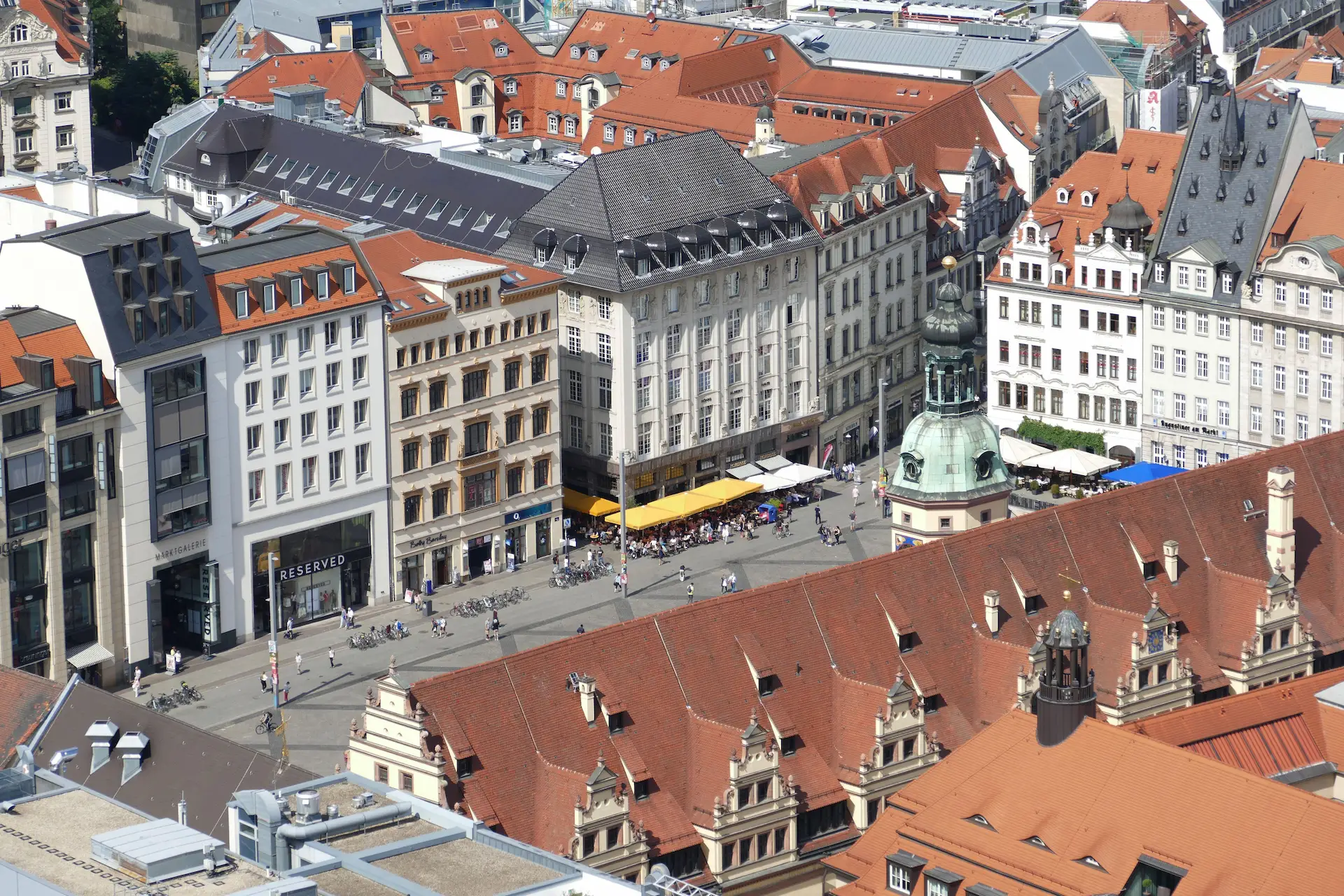
A few minutes on and you stand on the market, the historic heart of the center. Trade fairs and commerce were at home here for centuries, and today that mixes with everyday city life and visitors from everywhere. Tuesdays and Fridays you get the weekly market with regional produce, festivals and market days fill the gaps, and in winter the Christmas market packs the square right up to the facades. Under the paving since 2013 sits the Markt S-Bahn station. After the big City Tunnel build the square itself was relaid with natural stone and the city coat of arms back in the paving, and right in the middle the Old Town Hall sits with its Renaissance facade. The 1556 building is nearly a hundred meters long and since 1909 has housed the City History Museum. Inside, the permanent show walks you through Leipzig from the Middle Ages to now. You move through the great hall, council chamber and cellars and meet originals like the Haussmann Bach portrait. Bach was elected Thomaskantor here in 1723. Entry to the permanent exhibition is free, and the Old Town Hall itself is the strongest exhibit in the room.
Bach at St. Thomas Church
West of the market you find St. Thomas Church. Johann Sebastian Bach is buried here, and this is where the Thomaner sing, the world-famous boys’ choir of St. Thomas whose tradition reaches back to the Middle Ages. For a lot of music fans it is a pilgrimage stop.
St. Thomas is famous for its motets, a short musical service with the Thomaner choir. They happen Fridays at 6 pm and Saturdays at 3 pm, often with players from the Gewandhaus Orchestra. On Saturdays a Bach cantata regularly joins the program. Even without a motet the churchyard is worth it, with the Bach memorial. The balance between tourist magnet and everyday church life works in a quietly impressive way here.
Want to stretch the loop a bit? From the Bach quarter you walk to the New Town Hall on Burgplatz. The grand historicist building with the tall tower stands on the old Pleißenburg site and is one of the city’s stronger postcard shots. From there you are back near the ring and on the way home to the hotel.
Both churches and the market sit about fifteen to twenty minutes from the hotel, depending on your pace and how often you stop to linger.
Evening on the KarLi
If after the center you still want food, bars or a browse, the KarLi is the natural next move from here. Two streets west the axis toward Südvorstadt and Connewitz begins. Which stops are actually worth it, and how you walk in from both little BIG hotels, is in our KarLi guide.
Back at the hotel
When you have had a full day, you are quickly back on Paul-List-Straße from the market, the New Town Hall or Augustusplatz. Our Hotel am Bayrischen Platz is your home base south of the center, with S-Bahn and tram at the door and Bayerischer Bahnhof as the neighbor.
You will find some of the stops from this guide on the map.