
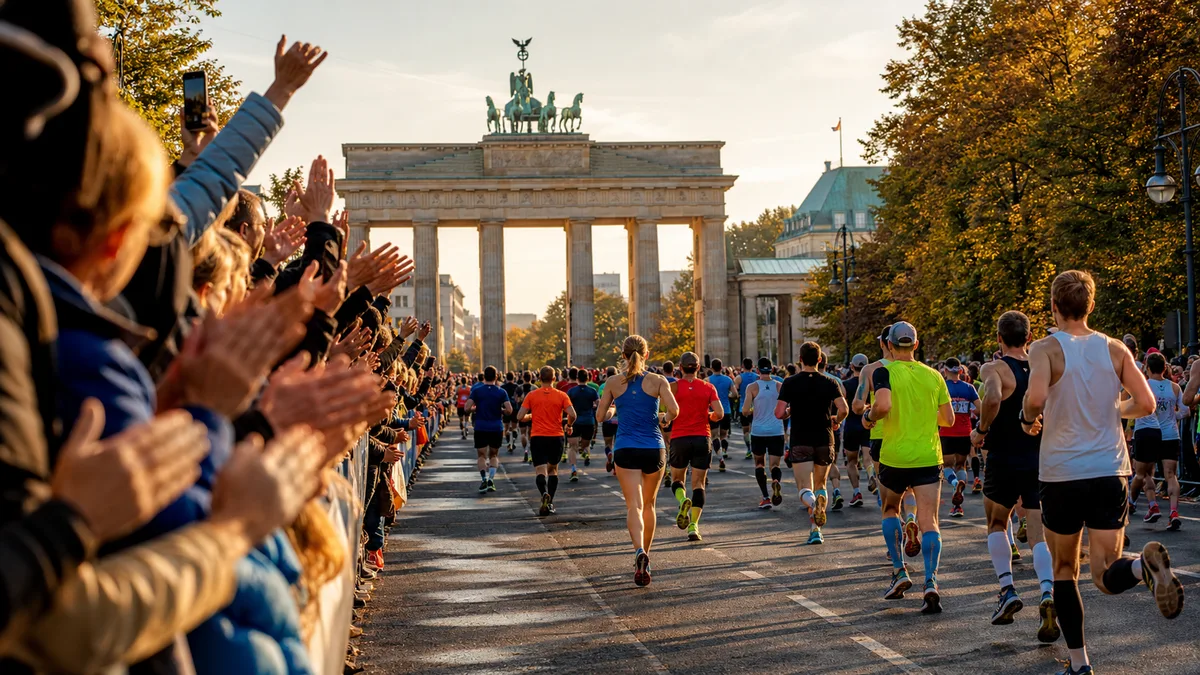
The Berlin Marathon transforms the city into a 42.195 km stage – world-class athletes, emotional stories and hundreds of thousands of fans lining the route.
Berlin Marathon 2026: The City in Running Frenzy
When Berlin suddenly pulses faster at the end of September, when people wait on street corners with cardboard signs, music sounds from loudspeakers, and the city transforms into a 42.195-kilometer stage for one day, then it’s Berlin Marathon time again. On September 27, 2026, the world runs through Berlin—and hundreds of thousands watch, cheer, support, root along, and turn this Sunday into one of the most emotional moments in Berlin’s event calendar.
For the runners, the Berlin Marathon has long been planned, as the starting place lottery has already taken place. Remaining starting places are in high demand, preparation is underway, and travel bags will eventually be packed with running shoes, gels, and good luck charms. But this article is primarily for everyone standing on the sidelines: for families, friends, partners, fans, hotel guests, Berlin visitors, and everyone who doesn’t have to run the marathon to still feel it.
Because the Berlin Marathon is not just a race. It’s a city experience. A Sunday full of movement, emotions, music, tears, pride, and that special moment when someone runs through the Brandenburg Gate after 42 kilometers and suddenly everything seems a bit bigger.
Why the Berlin Marathon is so special for spectators too
The Berlin Marathon is one of the world’s major running events and attracts people from countless countries to the capital every year. For many, Berlin is a dream race: fast, flat, international, iconic. But especially for spectators, it’s at least as impressive because you experience the city completely differently on this day.
Berlin becomes an open arena. Not in a stadium, not in a single location, but right across the city. You stand along the route, see the elite fly past, later the huge fields of recreational runners, in between wheelchair users, handbikers, costumes, club groups, running crews, people with personal stories, and supporters who wait somewhere between pride and nervousness for “their” person.
The beautiful thing: You don’t have to be a running nerd to get swept up. The marathon almost explains itself. Someone runs. Others cheer. And at some point you realize you’re shouting to complete strangers as if they were old friends.
The best spots for spectators
If you simply want to soak up marathon atmosphere, you’ll find many good points along the route. Particularly popular are the major Berlin moments: the Victory Column shortly after the start, the area around the Reichstag and Federal Chancellery, the Friedrichstadt-Palast, the Kaiser Wilhelm Memorial Church, Potsdamer Platz, Unter den Linden, and of course the Brandenburg Gate.
The Wilder Eber in Schmargendorf is also a really strong spectator point—and particularly exciting for guests of Anna 1908, as it’s easily accessible from there. This is traditionally where it gets loud: The samba percussion band Sacucaiu no Samba has been driving runners forward with plenty of rhythm around kilometer 28 for years. This is exactly where the toughest phase of the race begins for many recreational runners—making the energy at the roadside all the more important. So if you want to not just watch but really cheer, the Wilder Eber is a pretty good choice.
The choice of spectator point usually follows a strategy. If you want to cheer for someone personally, you shouldn’t just look for the most beautiful spot, but for accessibility, kilometer point, and recognizability. A sign, a conspicuous jacket, or a fixed meeting point can help, because with many people at the roadside, “we’ll definitely see each other” is rather optimistic.
The finish at the Brandenburg Gate is of course the big goosebump moment. However, it’s also particularly crowded there. If you want to see the finish, you should get there early and bring patience. Shortly before the finish there are publicly accessible standing tribunes; access is from the side of the Brandenburg Gate. The route in the finish area can only be crossed at designated points, so it’s best to follow the instructions on site.
Watching the marathon stress-free: how to plan your day
The most important tip: Don’t plan marathon Sunday like a normal Berlin day. Many streets are closed, some routes take longer, and public transport is a much better choice than car or taxi. If you want to visit several points along the route, you should roughly check beforehand which U-Bahn and S-Bahn connections make sense.
You’ll be even more flexible with a bicycle, though. With it, you can connect several spectator points much more easily, are more independent of crowded stations, and often get closer to the route than with other means of transport. Practical: In almost all little BIG hotels you can rent bicycles (except at the YARD). Especially for hotel guests who want to cheer for their runner at several points, the bike is often the most pleasant solution.
For supporters of runners, it can be nice to choose two or three realistic spots instead of planning five hectic changes. Better to be really visible at one point, cheer loudly, take a photo, and then move on relaxed. Particularly practical are locations with good public transport connections and clear orientation: such as City West, Potsdamer Platz, or the area Unter den Linden.
Also pack a bit like for a long walk: comfortable shoes, water, something warm for the morning, maybe a snack, and a phone with a full battery. At the end of September, Berlin can be wonderfully mild, but also cool, windy, or rainy. If you’re standing at the route for several hours, you’ll notice that faster than you think.
Berlin as a marathon stage: once across the city
The Berlin Marathon is also so beautiful because it tells the story of the city like a big sightseeing route. The course passes many well-known places and connects Berlin landmarks with neighborhoods, residential streets, grand boulevards, and small moments on the side.
For visitors, this is ideal. You can combine the marathon with a Berlin weekend and see a side of the city on Sunday that exists only once a year. Berlin is then not just a backdrop, but part of the experience: with music groups along the route, people on balconies, children with hand-painted signs, tourists alongside Berlin regulars, and this shared rhythm of applause, shouts, laughter, and amazement.
Especially if you’re in Berlin for the first time, you shouldn’t see the marathon just as a sporting event. It’s also a city feeling. Perhaps not the quietest Berlin day, but one of the liveliest.
For supporters: how to really help your runners
If you’re supporting someone running the Berlin Marathon, you have a small supporting role with a big impact. A good spectator point can mean incredibly much after 25, 30, or 38 kilometers. Sometimes a shout with a name is enough, a brief smile, a sign, or simply the certainty: someone is waiting for me.
Agree beforehand on roughly where you’ll be standing. Pay attention to whether your spot is on the right or left side of the route. Maybe send a photo of your jacket or sign in the morning. And if you miss each other: don’t dramatize. At a marathon, things happen, routes are crowded, times shift, and sometimes the person runs past faster or slower than expected.
After the race, a clear meeting point is worth its weight in gold. The finish area is emotional, crowded, and not always easy to survey. If you want to go back to the hotel together afterwards, it’s better to arrange a quiet meeting point outside the biggest hustle and bustle.
Marathon weekend in Berlin: not just Sunday counts
Even though Sunday is the big moment, a whole marathon weekend in Berlin is worthwhile. There’s already a special tension in the city beforehand. Runners pick up their documents, you see people in running shoes everywhere, the cafés around the city center get fuller, and Berlin seems a bit like it’s preparing for a shared starting signal.
For hotel guests who aren’t running themselves, this is a nice opportunity to experience Berlin in a relaxed way: arrive on Friday, stroll through the city on Saturday, maybe a light dinner with your running companion, Sunday to the route, and then celebrate together afterwards. Because whether it’s a personal best time, first marathon, or simply finishing: after crossing the finish line, Berlin can definitely be celebrated a bit.
Accommodation for the Berlin Marathon: our little BIG basecamp
For the Berlin Marathon, a good hotel location is particularly valuable. Not because you necessarily have to sleep right at the start, but because short distances, good public transport connections, and a quiet retreat make the weekend significantly more relaxed.
The fjord hotel berlin is on Bissingzeile in Tiergarten, less than ten minutes on foot from Potsdamer Platz, on a quiet side street, not on the square itself. A very good choice if you want to stay close to central marathon locations like Potsdamer Platz, the government district, and the Brandenburg Gate. Especially for spectators, the location is practical because you’re quickly in the middle of the action and still have a quiet place to arrive after the long day.
The LINDEMANN’S is a good fit for everyone who wants to experience Berlin a bit more urban yet still well connected. From here, you can easily combine both central route points and a relaxed evening in Schöneberg.
The Calma Berlin Mitte is ideal if you want to stay centrally but not sleep completely in the hustle and bustle. Mitte is well suited for a marathon weekend with sightseeing, the route, and short distances through the city.
The the YARD in Kreuzberg is a nice choice if you want to combine the marathon with restaurants, bars, cafés, and a somewhat livelier Berlin feeling. Kreuzberg is particularly suitable for everyone who doesn’t want to fall straight into bed after the race, but let the evening wind down a bit.
And Anna 1908 is pleasant for everyone who wants to arrive a bit more quietly in the southwest after an intense marathon day—with good connections and a relaxed distance from the big inner-city hustle and bustle.
For supporters: When booking, think not just about marathon morning, but also about afterwards. Shower, quiet, breakfast, and short distances can be almost as important after such a day as the perfect spectator spot.
Our tip for the Berlin Marathon 2026
Don’t turn the marathon into a pure waiting day. Of course the race is the focus, especially if you’re supporting someone. But Berlin gives you so much atmosphere on this Sunday that watching is worthwhile in itself. Find yourself a nice spot, take in the mood, cheer for strangers too, and let yourself get a bit infected by this mix of sport, city, and emotion.
The Berlin Marathon 2026 on September 27 is one of Berlin’s great autumn moments. For runners, it’s a goal. For everyone else, it’s a pretty good reason to visit Berlin exactly when the city shows how loud, warm, and moving it can be.